Here are the slides I used for a talk on Gaian DB – a dynamic, distributed, federated database technology that we produced at work and have made available through IBM alphaWorks.
GaianDB – my talk at bathcamp 2010
October 30th, 2010Great South Run
October 29th, 2010It’s safe to say that I’ve been a stereotypical geek where sports are concerned. You know the sort – always picked last for sports at school, and came up with a variety of ways to avoid P.E. lessons wherever possible (helped by a secondary school that let me swap PE classes for additional academic classes).
Last February, a mate suggested that I join him to do the Great South Run – a ten mile run in Portsmouth. My initial reaction was that I could never do that. I’d never run a mile before, let alone ten. And I hadn’t done any running at all since school.
But then… the fact that I’d never done anything like it before also seemed like a good reason to do it. So, I signed up.
Why you want code monkeys who tinker in their own time
October 14th, 2010This post is a modified version (in other words, shameless rip-off!) of an interesting post on seo-chicks.com. It talked about why companies should expect their SEO specialists to moonlight in their own time, and the benefits of this. You should go and read the original article as it’s really good.
But as I read it, I saw a parallel with how big software companies like my own employer should view their developers…
There are many reasons why you should expect your developer to be working on their own projects. Your developer should be doing something besides showing up to work, working on clients (or in house) and going home.
Working on their own projects is essential because it gives them experiences beyond their immediate work and gives them a platform for experimentation. Better that they try and fail on their own side projects than on your enterprise software products or your client’s live systems.
Software development is an art and a craft. It takes skill, knowledge, understanding and learning. Training is sparse once beyond the beginning stages, particularly in recent times where training budgets are getting harder to justify. Practice and experience are good forms of training – finding out the hard way what works and what doesn’t.
A passionate developer, someone who is bitten by the bug and craves to learn more, will go on to do more code development in their free time. That is the code monkey that you want – someone who has passion and strives to learn more. This is the developer that you should want to find and keep. The professional who will test, push boundaries, experiment and learn more in their free time is valuable and should be kept and nurtured. This developer will bring more to an organisation than you may be able to utilise however they are worth their weight in gold over the long term.
Eating in the dark
September 30th, 2010
Friday was Amy‘s birthday. I probably shouldn’t share which birthday.
For her birthday, we went to London for the weekend, doing touristy things like the London Eye and shopping stuff like Selfridges and Liberty. For her birthday meal, I thought of trying something a bit different and booked us a table at Dans Le Noir. It’s an unusual restaurant, so I thought it was worth sharing a little about the experience.
I know I tend to ramble, so let me get a short version out of the way: you have to eat in the dark, and it’s pretty intense.
What does Solent Youth Action do?
September 27th, 2010Told in pictures. I thought this was kinda neat.
What will happen to v?
September 13th, 2010Solent Youth Action‘s biggest project is vinvolved – delivering the vinvolved national volunteering programme.
When I say it’s our biggest project, there are different ways you could measure this – number of young people helped, number of volunteering hours contributed, etc. It’s not a definitive thing.
One way of measuring is by income. Our finances are all on the charity’s website, but let me pick out a small summary.
The funding we receive from vinvolved is the darker purple bit. The point I’m making is that they pay for a lot of what we do.
Making National Traffic Control data more useful
September 12th, 2010or ‘my hack for Over The Air 2010’
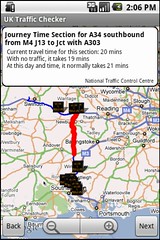 Yesterday was Over The Air 2010 – a very cool event for mobile developers, that really warrants a post to itself, but I’m too tired so that will have to wait for another day.
But while I was there, I had a go at the hack challenge. I’m pleased that there was a fair amount of interest in what I did, so in this post, I want to share some of the technical details.
The hack centred around getting access to (pseudo-)realtime data about UK roads. It turns out that there is an effort to make traffic and road monitoring data available in a consistent, interchangeable format: DATEX II.
The DATEX site has a list of documentation for the traffic data made available for England, Scotland, Sweden, Italy, Spain, Portugal, Netherlands, and regions in France and Germany. For a data geek, this was quite a cool find 🙂
I only had 24 hours to play, so started with the data available for England – covering the motorway and trunk roads. The web page includes a 39-page PDF which documents the data that the National Traffic Control Centre publishes for England.
The nice thing about DATEX II being an agreed standard is that although I spent the evening working with the English traffic data, once the code was done, there wouldn’t be anything to stop me using the same code with the Scottish data too.
They publish a lot of data – more than I realised was being collected, let alone made publicly available. This chimed well with the keynote on Saturday morning by the brilliant Tim Berners-Lee, in which he talked about the importance of publicly available data.
The data includes:
- current and future planned roadworks
- current and future planned events expected to affect traffic
- unplanned events affecting traffic
- the current message being displayed on variable message signs (the electronic traffic signs that can be set to display text messages like “don’t drink and drive”)
- the current graphic being displayed on matrix signs (those square electronic displays that can display icons like which motorway lanes are closed)
- information about traffic on monitored stretches of road
This was an impressive list – is it just me, or is the ability to find out what is currently written on the electronic sign hanging over every major road in the country seriously cool? No? Okay… so I’m a geek. 🙂
But beyond the list, what was impressive was the amount of detail.
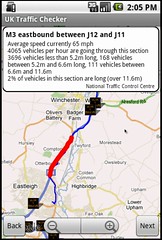 For roadworks, you can find out not only where they are, but what type of roadworks they are – e.g. resurfacing, barrier repairs, bridge repairs, etc., what times of day they will be active, when they are expected to finish, the anticipated level of disruption, number of lanes to be closed, and much more.
For events, you can find out the type of event (e.g. if it’s a sports event what type of sport, if it’s an entertainment event what type of entertainment – e.g. boat show), as well as details about times, expected level of disruption, and so on.
For unplanned events, there are codes for a variety of types of events e.g. Spillages are divided into types like chemical, oil, and – unusually – “shed load”. Accidents are categorised into serious, multi-vehicle, vehicle fire, vehicle recovery, overturned vehicle, and so on. Other event codes include animals on road, people on road, obstructions, severe weather like fog, rain, snow, ice, high winds, etc. And loads more. And again, you get all the detail about times, level of disruption and so on.
For the variable message signs, you get the message text itself, the location of the sign, the source of the message (which authority set it), and so on. For the matrix signs, you get the code for the icon being displayed, the location of the sign, the time the message was set, etc.
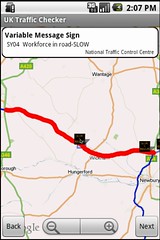 For the traffic data, you get data divided into monitored stretches of road. In the England data, there were tens of thousands of these road sections. For each stretch of road, you get:
- current average travel times to traverse the section
- the typical travel for this stretch of road for this time and day of the week based on historical profiles
- the theoretical ideal travel time if there was no traffic
- the current average vehical flow rates (number of vehicles per hour) divided into the length of vehicle – how many vehicles shorter than 5.2m, how many vehicles between 5.2m and 6.6m in length, how many vehicles between 6.6m and 11.6m, and how many vehicles longer than 11.6m (the doc warns that “The accuracy of the loops when classifying vehicle lengths is 1% so measurements around each breakpoint could fall into adjacent categories” – like that’s a problem!)
- the current average vehicle speeds on the stretch of road
- the current average occupancy for the road
Not only was it detailed, but it was up-to-date. Data is updated at two-minute intervals if you pay for a premier account, or ten minute interals for the free standard account.
This was awesome. So much information!
What impact does SYA have on the community
August 21st, 2010 Last week, some of the staff and trustees of Solent Youth Action had an Away Day for strategy and planning a-plenty.
In one of the morning activities, we were ideastorming in small groups. My group had to identify what impact SYA has on the community.
I kinda liked the list we came up with. As the work of ten minutes or so of ideastorming, it’s not definitive or official in any way. But I thought it warranted sharing.