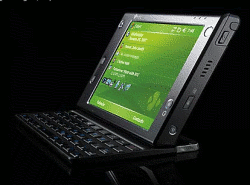
RE: T-Mobile Ameo… first impressions

April 2nd, 2007

HTC promo photo of my PDAI’ve been using the T-Mobile Ameo for a couple of weeks now – so now I’ve given it a proper try I thought I’d post my conclusions. (And then shut up about it πŸ™‚ )

Feature-wise, the Ameo is hard to argue with – it has pretty much everything that I might want. The question is more about whether it’s a good device to use, particularly considering it’s size. The answer – perhaps somewhat predictably – depends on how you use a mobile device.

Read the rest of this entry »

T-Mobile lets you know when you miss calls

April 2nd, 2007

I just got a text message letting me know that I missed a phone call this morning. I’m new to T-Mobile (I’ve been with O2 for ages) and didn’t realise that they did this.

From their website:

Phones usually only track your missed calls when your line is busy or you don’t answer – that’s no longer the case now we’ve launched Who Called.

Who Called provides you – via text – with details of the last five unique missed calls you’ve had in the previous three days.

We send you texts with details of calls received while your phone was unreachable (out of coverage or turned off) – providing no voice message has been left.

With O2, if someone phoned me while my phone was out of coverage (not unusual here at Hursley, annoyingly) or switched off, I’d never know unless they left a message – something most people don’t do.

This is quite a neat idea πŸ™‚

What’s in a name?

April 1st, 2007

For the young people who do Millennium Volunteers, today’s transfer of MV from the DfES to the new independent charity ‘v’ is probably a non-event. I imagine many of them won’t notice at all – and “business as usual” is certainly the message that v is encouraging us all to send to them.

The most noticeable difference will probably be the change to the certificates that young people get after completing 200 hours of voluntary work. Before today, the certificates were signed by a government minister – because they were the responsibility of the DfES. Now that link has gone, the certificates from today will be signed by the Chief Exec of the new charity v – Terry Ryall.

Read the rest of this entry »

vcashpoint

April 1st, 2007

One of the things I found out about at the v conference on Thursday was vcashpoint.

vcashpoint is their “funding initiative” where they will give money directly to young people to fund set up voluntary community projects. The idea is that if a young person (aged 16-25) has an idea for something that they think will benefit their community, they can apply to v for a grant of up to £2,500 to help them make it happen. Successful applicants get the money transferred to a bank account of their choice, and v monitor the outcome of the project in much the same way that they would with a voluntary provider like us.

Read the rest of this entry »

Battery tip for keeping smartphones online

March 29th, 2007

A quick tip I picked up for getting more out of your battery while using a smartphone away from a power source for a day or two. Set the network type to GSM only – ignoring 3G. If you’re not web browsing and are only relying on connectivity to periodically check your email inboxes, then you won’t notice any real difference. But you’ll get extra hours out of your battery!

In Windows Mobile you can do this from:
Start -> Settings -> Phone -> Band – changing the setting from Auto to GSM.

This particularly makes a difference if you’re travelling (like when I’ve been working this week on the train to London), or are in an area where the 3G coverage isn’t great. This is because having your phone repeatedly flick back and forth between using GPRS and UMTS really chews up your battery life.

When you get to where you are going (and are in an area with a decent 3G connection) you can always switch the setting back to UMTS and get the benefits of the faster connection.

Finding out about v

March 29th, 2007

I’m sat on a train, on my way to a one day “Welcome to v” conference. I’ve mentioned v many times now – this is the group that is taking over the running (and perhaps more importantly, the funding) of Millennium Volunteers (MV) from the DfES.

Millennium Volunteers is our biggest single source of funding in Solent Youth Action, so v is obviously important to us.

They have invited MV providers to come to London and hear about what they have done to date, and their plans for the future – including (finally!) some details about how they will be managing and monitoring the MV projects.

There is also something in the timetable about discussion and small group sessions to get our views on the shape of the new “National Youth Volunteering Programme”.

Plus, I imagine it’ll be the usual chance to network with other youth charities.

I am a little weird

March 29th, 2007

I had to drive to the New Forest Children’s Services Centre in Bartley yesterday for a strategy meeting. I’d never been there before, so had to use the sat nav on my new PDA to get me there. But as I’ve only had the PDA for a week, I haven’t got round to getting a car mount that will fit it yet, and had to rely on the voice directions.

Is it very wrong that driving along with a computer telling me what to do reminded me of Knight Rider? πŸ™‚

Twitter for youth groups

March 25th, 2007

I’ve been setting up some Twitter accounts for us to use in Solent Youth Action. I won’t go into too much detail about what Twitter is, as everyone already seems to be talking about it!

I think it could be a useful tool for us to use with some of our youth groups. By setting up a Twitter page for each youth group, and inviting the youth group members to register as “followers”, we can send them text messages to their mobile phone.

For example, we can quickly send out a reminder before an event by filling out a web form (or by sending a text message). The message will be sent as an SMS to all members of the group in one go, and at no cost to either us or the young people!

It might not be a perfect fit – the 140 character limit on messages could be restrictive, and it isn’t really intended for this sort of use. That said, there doesn’t seem to be any sign that Twitter mind people finding alternative uses for it (e.g. the BBC News Twitter feed) and services like Jyngle which are a better match are not yet available in the UK.

I think it could be useful – it’s a very immediate form of messaging, and is a preferred method for many of the young people that we work with – more so than email, for example.

We’ll give it a try with one of our smaller groups first and see how it goes. If it goes well, I can see us using it as a communications method with all of our groups.