
Happy Birthday to me, Happy Birthday to me…
Happy Birthday to me, Happy Birthday to me…
 Last Saturday was our wedding anniversary, so to celebrate I took Amy to London for Secret Cinema.
I wanted to share what we thought, but as the current Secret Cinema is still going, I’ll try and do it without giving away any specifics which would spoil it for people who haven’t been yet!
If you want a real review, reviews of previous Secret Cinemas are good for getting the idea
In a nutshell, Secret Cinema is going to watch a film, without knowing what film you’re going to watch or where you will be watching it. But that doesn’t really explain why it’s so much fun…
Until this month, I had an Android app which displayed road traffic problems on a given route.
It was a fairly simple app, but kinda useful and managed to find 33,000 or so users.
But it’s stopped working. It was using a bunch of travel news feeds from BBC Backstage.
Those feeds now all return:
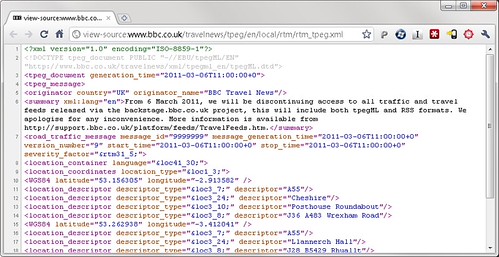
…we will be discontinuing access to all traffic and travel feeds released via the backstage.bbc.co.uk project, this will include both tpegML and RSS formats…
In the short-term, I can’t find a straightforward replacement (a free and open source of feeds for local traffic and travel news) and so I’ve unpublished the app from Android Market. Sorry.
(I have tinkered with writing my own feeds from NTCC data, which is something I’ve played with before. This is technically do-able – I’ve already written a basic PoC to demonstrate, but there are issues – such as I’d need to pay for the hosting of it, and the data only covers motorways and trunk routes unlike what the BBC had. So not sure whether this is a realistic option.)
Last Wednesday, Grace and I went up to the NEC in Birmingham for Gadget Show Live.
Overview
A long, rambly and very geeky post without a proper ending about some of the challenges I recently had getting WebSockets to work with mobile Safari on the iPhone/iPad.
Background
I wrote last week about a recent project of mine – a proof-of-concept using a custom WebSockets server implementation to push messages to web apps.
A target platform for one of the demos that I wrote to go with this was the iPhone. But it wasn’t as straightforward as I’d hoped. And I’ve ranted enough about it to friends and colleagues and on twitter. About time that I did a bit of moaning here 😉
Overview
 A bit of science fun for Grace. We made a battery out of zinc washers and copper coins.
Read the rest of this entry »
I keep hearing volunteers referred to as free labour – normally in the context of the “Big Society” being a way to replace paid employees with volunteers because they’re free. But at a time when policymakers talk about wanting to encourage big increases in levels of volunteering, some volunteering charities are struggling to find funding.
A point that doesn’t seem to be well recognised in mainstream media coverage of the Big Society is that volunteers are not free. In fact, they can be very expensive.
Volunteers need to be supported. (Obviously, I’m talking in the context of Solent Youth Action – a charity that focuses on enabling young people to volunteer. But still…)
Someone needs to look out for and help to create opportunities for people to volunteer.
Someone needs to check that a volunteering opportunity is safe, that the role is appropriate, and that the volunteer will be adequately supported.
Someone needs to identify any training or preparation required for a volunteering role, and help the volunteer to find the training they need – whether it’s getting a food hygiene certficate for volunteering in a community kitchen, or getting training to help prepare them for working with people with special physical or learning needs.
Someone needs to encourage the volunteer to review and reflect on what they’ve done, and what they got out of it.
I could go on, but you get the idea. The point is that to do volunteering properly (where a volunteer is supported in carrying out a well-defined and appropriate role for which they are properly prepared) takes work. And that work has a cost.
Overview
Extending WebSphere MQ to include support for WebSockets, allowing messaging to web browsers, including mobile browsers, without any additional client software
Background
I’ve talked about MQTT before – a lightweight messaging protocol that I’ve used both on personal projects and my day job.
From mqtt.org:
It is useful for connections with remote locations where a small code footprint is required and/or network bandwidth is at a premium.
I’ve used it in CurrentCost projects, mobile apps and with small and embedded computers like my Slug.
But in all cases, I’ve needed MQTT client software to talk to the messaging server. Whether writing in C, C#, Java or Python, I’ve needed a client library to get me started, something that knows the sequence of packets that make up the MQTT protocol.
It’d be useful to have a zero-install MQTT client: an MQTT client app delivered over the web, without the user needing to install any additional client libraries, or resort to Java applets.
What this does
One possible way to do this could be WebSockets. Part of HTML5, this is a protocol that describes how to do two-way messaging between web servers and web browsers. And I mean proper two-way communication, including push-notification from the server to the browser, without resorting to hacks or kludges like long polling or hidden iframes.
It’s an emerging protocol, still in draft form, but there are a few implementations around so there are already a few browsers that know how to manage WebSockets.
We’ve been exploring recently how this could work with MQTT – the aim was to build in support for WebSockets into an MQTT messaging server: IBM WebSphere MQ (WMQ).
I’ve mentioned WebSphere MQ before, as back in the dim-and-distant past (well, five or six years ago) I used to be a developer of it.
It’s one of the server implementations that support the MQTT protocol.
By adding support for WebSockets to it, it means that WMQ could send and receive messages to web browsers. It means a web app could be a fully-fledged MQTT client.