Making an offline copy of a wiki

February 9th, 2008

We use a Confluence wiki for one of the projects that I work on. Wikis can be a fantastic tool for collaboration, and this wiki is a single place where we can share information and our progress.

But we’ve been having problems with the reliability of the wiki – it is unavailable at times, and can be painfully slow at others. Key information that I need is in that wiki, and when the wiki goes down it can be difficult and frustrating.

Yesterday, I had a play with wget to try and download an offline copy of the wiki to use as a backup for when it isn’t working or is going painfully slow.

I’ve put the steps I took here, in case they will be useful for others.

Read the rest of this entry »

Support U 2

February 8th, 2008

An article I wrote for the Hursley intranet. There is nothing confidential in it (and it took me long enough to write!) so I thought it’d be good to share.

The first phase of Support U 2 – a pilot mentoring project for young people run between business, charity, and government agency – came to an end with a celebration evening in the Clubhouse.

What was the project all about?

Support U 2 was started to help hard to reach young people – people not in education, employment or training, and identified as being unlikely to change this without some additional effort.

IBM’ers are already mentors for young people through programmes like MentorPlace. Youth charity, Solent Youth Action (SYA), work with young people through volunteering placements, activities and youth groups. Government agency Connexions provide advice and counselling to young people.

All of this happens already, and makes a massive difference to the lives of thousands of young people.

The unique aspect of Support U 2 was how these organisations worked together. The project brought them together to make a focused, coordinated effort to change the lives of young people identified as being at risk of remaining NEET.

Rather than offer separate programs, they pooled our resources – IBM’s business expertise, Connexions’ expertise at working with NEET young people, and SYA’s expertise at finding young people engaging, educational placements and activities. This was brought together to produce an intensive, coordinated package, tailored to each young person.

Read the rest of this entry »
Donating for freeware

February 7th, 2008

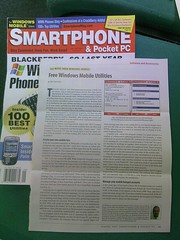
If I’ve ever talked to you about Windows Mobile, the chances are I’ve probably mentioned my wiki note-taking app. Of all of the bits of mobile code hacking that I’ve done, it is the one that (a) I dont seem to shut up about, and (b) has been one of my most popular*.

The app has been around for over a year now, and gets downloaded from about 1000 – 1700 unique IP addresses each month (Plus a few thousand more from mirrors on freeware sites).

The forum set up for users to report bugs and request features has over sixty active users.

And I generally get emails from 20 or 30 other people with requests each month who don’t want to use the forum for whatever reason.

I’ve even had emails from people using the app far more than I ever envisaged: people who are using the wiki as a work intranet wiki, installing a copy for each of their staff; people who use the wiki to maintain and develop websites; and more.

It would seem that there is an audience and a demand for this app.

Nearly a year ago, I decided to try a little experiment to see how this demand would translate into people prepared to pay for it.

Read the rest of this entry »

Writing a mobile password manager

February 7th, 2008

I miss developing mobile apps. With the exception of the never-ending tweaks and revisions to my mobile wiki app, I’ve not done any mobile development in weeks. (Is it very sad that I missed it? 😉 )

Until tonight. Hurrah – back to playing with fun stuff.

One of the things I typically want to use on my phone is a mobile password manager – particularly as I do more web browsing on my phone, and mobile browsers like Pocket Internet Explorer and Opera Mobile don’t remember passwords.

I’ve tried several existing password managers – I’ve even paid for a couple, like eWallet (love the way it shows credit card details to look like a pretend credit card) and SplashID (always loved the desktop version). But I never found one that I really liked. At the moment, I’m back to storing passwords in a text file, and using mobile Notepad to access it.

There were problems with all of them…

One-handed or stylus-free navigation is bad – Teeny-tiny controls. Drop-down lists that you need to not only touch the screen to open, but then scroll up and down in. Basically, take a look at a design doc like this and do the opposite of pretty much everything 🙂

Too many clicks/presses to get to a password – SplashID for example: to get a website password, you touch the screen to open the category drop-down list, touch the screen to scroll to the “Web Logins” category, scroll through the list to the website you want, touch the screen to select it, press the “Tools” button, then press “Unmask Fields”. Too much.

No clipboard access – Unforgivable, this one. I like to use randomly generated passwords where possible. Once you’ve used the fiddly controls, and gone through all the steps, you can see the password on the screen – hurrah! Can you copy it to the clipboard for pasting into a web form? Nope. Even Ctrl-C / Ctrl-X / Ctrl-V don’t work – and most apps at least leave that basic Windows clipboard support in. So you have to remember your password after reading it. And with my passwords, that’s a pain. I used to find a scrap of paper, and write it down to make it quicker to type back in. So secure(!)

Actually, to be honest, even after all that, the final straw that stopped me using SplashID was the fact that it’s sync plugin consistently hosed my ActiveSync. Not only would it not sync, but it’d crash ActiveSync and stop everything else from syncing too. The day I uninstalled SplashID, my phone became a million times more useful from that alone!

This was all enough of an excuse to try throwing together my own password manager.

Read the rest of this entry »

Me & U

February 6th, 2008

I don’t often blog about work that we do in Solent Youth Action. Not sure why. Perhaps because the best stuff we achieve isn’t normally something tangible I can pick up and show people.

But today it is – because today I got a proof copy of a booklet that we’ve produced that I wanted to share.

Me & U (“My Emotions Understood”) is a project we’ve been running with the Brookvale Youth Mental Health Team. The idea was to work with young people who have experienced mental health illnesses and support them to write a book of thoughts and poetry that could raise awareness of mental health issues. Through the production of the booklet, we supported the young people to try and explain the emotional experience of a young person with mental health issues.

They’ve managed to produce a stunning booklet that is as moving as it is informative. It’s an amazing achievement and, I think, very unique.

When I try and explain what “Solent Youth Action” does, people sometimes find that it isn’t what they might have first expected from a youth volunteering charity. I’ve blogged before that “volunteering” can take many forms, and this is another fantastic example.

matter

February 2nd, 2008

the "matter" box arrivesI signed up to matter a little while ago. It’s a service where you sign up to be sent promotional stuff.

If you look at their website or their blog, they don’t really describe themselves like that. They talk about it as a “communications channel” between consumers and advertisers, and they talk about the “brand experience”. In fact, they say pretty much everything except “we’ll give you free stuff”.

even before it's opened, she likes it :-)In the lead up to today, they’ve talked a lot about the care they’ve been taking to select interesting things that “you’ll want to keep”. Even so, my hopes weren’t very high. This is all free, so I was a little sceptical how good the stuff would be. Today, the pilot matter box arrived.

Read the rest of this entry »

Thinking out loud: PowerShell support for DB2?

January 31st, 2008

My PowerShell library for WebSphere MQ has been out for a month or so now, and it seems to have been well-received. I’ve seen a surprising amount of blog posts and news articles about it, the download stats for the SupportPac are very encouraging, and I’m getting a steady (if slowly growing) stream of emails with requests for help and new features.

There is still more to finish with the WMQ library – the biggest piece of outstanding work is adding support for z/OS queue managers, but there are a few other bits and pieces to do as well.

But even so – with my usual attention span of an easily distracted child, I’m starting to look at what I might try next.

I’m thinking a PowerShell extension for DB2 might be a good next step.

Why?

  • Like WebSphere MQ, the prospect of writing it is made much easier by the fact that there is already a .NET API and support for building C# applications for DB2
  • Database administration seems to lend itself quite well to PowerShell’s object-oriented nature. Using Select, Where, et al. still reminds me of SQL pretty much every time I type it
  • I know very little about DB2, and it’d be a chance to learn something new

Okay, so my third reason sounds a little weak, but on a personal level, it’s a consideration.

But would there be a demand for supporting DB2 administration using PowerShell? I don’t know… I’ve not heard anyone ask for it, and other than a post on a developerWorks forum, I haven’t been able to find much of a call for it.

Still, it’s an interesting idea.

Adding remote system admin support to PowerShell (before PowerShell V2)

January 17th, 2008

Jeffrey Snover of Microsoft has written a very interesting post on PowerShell cmdlet development, prompted by the release of my latest updates to the WebSphere MQ PowerShell cmdlets.

By way of background, the cmdlets let you administer WebSphere MQ from the Windows PowerShell command prompt and scripting environment. One of WebSphere MQ’s biggest strengths is the breadth of it’s platform support, so it was no surprise that one of the most requested features to be added to the cmdlet library has been to be able to use PowerShell with WebSphere MQ queue managers on non-Windows servers.

Read the rest of this entry »