In this post, I want to suggest some approaches for introducing event-driven architecture patterns into your existing application environment. I’ll demonstrate how you can incrementally adopt Apache Kafka without needing to immediately build new applications or rebuild your existing applications, and show how this can be delivered in Red Hat OpenShift.
Archive for the ‘code’ Category
Taking your first step towards an event-driven architecture
Friday, December 3rd, 2021Describing Kafka security in AsyncAPI
Wednesday, November 17th, 2021As part of AsyncAPI Conference this week, I ran a session on how to describe Kafka security in AsyncAPI.
The aim of the session was to quickly show how to describe the security configuration of a Kafka cluster in an AsyncAPI document.
And, in reverse, if you’ve been given an AsyncAPI document, to show how to use that to configure a Kafka client or application to connect to the cluster, using the details in the AsyncAPI spec.
The recording and the slides I used are below.
Processing Apache Avro-serialized Kafka messages with IBM App Connect Enterprise
Monday, October 25th, 2021UPDATE: Please see the updated version of this post
IBM App Connect Enterprise (ACE) is a broker for developing and hosting high-throughput, high-scale integrations between a large number of applications and systems, including Apache Kafka.
In this post, I’ll describe how to use App Connect Enterprise to process Kafka messages that were serialized to a stream of bytes using Apache Avro schemas.

Background
Best practice when using Apache Kafka is to define Apache Avro schemas with a definition of the structure of your Kafka messages.
(For more detail about this, see my last post on From bytes to objects: describing Kafka events, or the intro to Avro that I wrote a couple of years ago.)
In this post, I’m assuming that you have embraced Avro, and you have Kafka topics with messages that were serialized using Avro schemas.
Perhaps you used a Java producer with an Avro SerDe that handled the serialization automatically for you.
Or your messages are coming from a Kafka Connect source connector, with an Avro converter that is handling the serialization for you.
Or you are doing the serialization yourself, such as if you’re producing Avro-serialized messages from a Python app.
Now you want to use IBM App Connect Enterprise to develop and host integrations for processing those Kafka messages. But you need App Connect to know how to:
- retrieve the Avro schemas it needs
- use the schemas to turn the binary stream of bytes on your Kafka topics into structured objects that are easy for ACE to manipulate and process
Stock price events for Kafka
Saturday, August 28th, 2021I’ve made a Kafka Connect source connector for sending “real-time” (not really) stock price events to a Kafka topic.
Choose your stock (e.g. “IBM“) and run the Connector pointed at your topic, and every minute a JSON event will be produced like:
{"open":137.9,"high":137.9,"low":137.9,"close":137.9,"volume":500,"timestamp":1629421200,"datetime":"2021-08-19 20:00:00"}
Visualizing TensorFlow image classifier behaviour
Saturday, July 10th, 2021How to use Scratch to create a visualization that explains what parts of an image a TensorFlow image classifier finds the most significant.
An image classifier recognizes this image as an image of The Doctor.
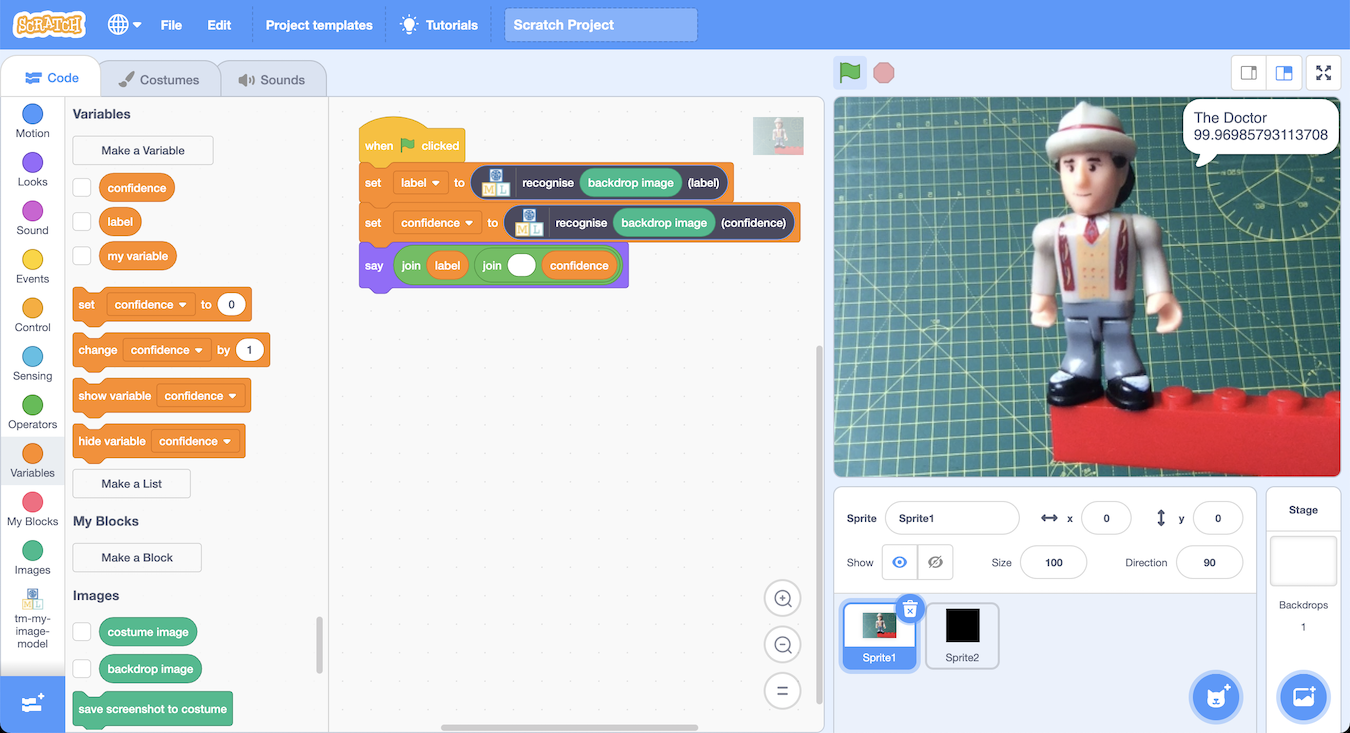
prediction: The Doctor
confidence: 99.97%
Why? What parts of the image did the classifier recognize as indicating that this is the Doctor?
How could we tell?
Describing Kafka security in AsyncAPI
Tuesday, June 29th, 2021The new version of AsyncAPI, 2.1.0, was released today. One of the updates is that it lets you describe Kafka security mechanisms and protocols. In this post, I’ll show how you can do this, and how it relates to configuring a Kafka client.
| Kafka config | means | AsyncAPI | |||
|---|---|---|---|---|---|
sasl.mechanism |
security.protocol |
encryption? | auth? | server protocol |
security scheme type |
| unset | PLAINTEXT |
no | no | kafka |
|
PLAIN |
SASL_PLAINTEXT |
no | yes, using SASL/PLAIN | kafka |
plain |
SCRAM-SHA-256 |
SASL_PLAINTEXT |
no | yes, using SASL/SCRAM | kafka |
scramSha256 |
SCRAM-SHA-512 |
SASL_PLAINTEXT |
no | yes, using SASL/SCRAM | kafka |
scramSha512 |
OAUTHBEARER |
SASL_PLAINTEXT |
no | yes, using OAuth | kafka |
oauth2 |
GSSAPI |
SASL_PLAINTEXT |
no | yes, using GSSAPI | kafka |
gssapi |
| unset | SSL |
yes | no | kafka-secure |
|
PLAIN |
SASL_SSL |
yes | yes, using SASL/PLAIN | kafka-secure |
plain |
SCRAM-SHA-256 |
SASL_SSL |
yes | yes, using SASL/SCRAM | kafka-secure |
scramSha256 |
SCRAM-SHA-512 |
SASL_SSL |
yes | yes, using SASL/SCRAM | kafka-secure |
scramSha512 |
OAUTHBEARER |
SASL_SSL |
yes | yes, using OAuth | kafka-secure |
oauth2 |
GSSAPI |
SASL_SSL |
yes | yes, using GSSAPI | kafka-secure |
gssapi |
| unset | SSL |
yes | yes, using mutual TLS | kafka-secure |
X509 |
How to avoid SSL handshake errors in your Kafka client because of a self-signed cluster CA
Sunday, June 27th, 2021You’re trying to connect a Kafka client to a development Apache Kafka cluster which has been quickly set up using a self-signed CA certificate. You don’t have a copy of that CA certificate, and (because it’s not signed by a well-known CA) your Kafka client is failing because of SSL handshake errors.
The error contains messages like
org.apache.kafka.common.errors.SslAuthenticationException: SSL handshake failed
and
javax.net.ssl.SSLHandshakeException: PKIX path building failed: sun.security.provider.certpath.SunCertPathBuilderException: unable to find valid certification path to requested target.
For example:
$ ./bin/kafka-console-consumer.sh \
 --bootstrap-server dale-kafka-saslscram-bootstrap-strimzi.apps.eem-test-fest-6.cp.fyre.ibm.com:443 \
 --topic DALE.TOPIC \
 --group dalegrp \
 --consumer-property 'security.protocol=SASL_SSL' \
 --consumer-property 'sasl.mechanism=SCRAM-SHA-512' \
 --consumer-property 'sasl.jaas.config=org.apache.kafka.common.security.scram.ScramLoginModule required username="dale-user" password="pSRtfwTMKNlz";'

[2021-06-27 23:19:06,048] ERROR [Consumer clientId=consumer-dalegrp-1, groupId=dalegrp] Connection to node -1 (dale-kafka-saslscram-bootstrap-strimzi.apps.eem-test-fest-6.cp.fyre.ibm.com/9.46.199.58:443) failed authentication due to: SSL handshake failed (org.apache.kafka.clients.NetworkClient)
[2021-06-27 23:19:06,049] WARN [Consumer clientId=consumer-dalegrp-1, groupId=dalegrp] Bootstrap broker dale-kafka-saslscram-bootstrap-strimzi.apps.eem-test-fest-6.cp.fyre.ibm.com:443 (id: -1 rack: null) disconnected (org.apache.kafka.clients.NetworkClient)
[2021-06-27 23:19:06,069] ERROR Error processing message, terminating consumer process:  (kafka.tools.ConsoleConsumer$)
org.apache.kafka.common.errors.SslAuthenticationException: SSL handshake failed
Caused by: javax.net.ssl.SSLHandshakeException: PKIX path building failed: sun.security.provider.certpath.SunCertPathBuilderException: unable to find valid certification path to requested target
	at java.base/sun.security.ssl.Alert.createSSLException(Alert.java:131)
	at java.base/sun.security.ssl.TransportContext.fatal(TransportContext.java:326)
	at java.base/sun.security.ssl.TransportContext.fatal(TransportContext.java:269)
	at java.base/sun.security.ssl.TransportContext.fatal(TransportContext.java:264)
	at java.base/sun.security.ssl.CertificateMessage$T13CertificateConsumer.checkServerCerts(CertificateMessage.java:1339)
	at java.base/sun.security.ssl.CertificateMessage$T13CertificateConsumer.onConsumeCertificate(CertificateMessage.java:1214)
	at java.base/sun.security.ssl.CertificateMessage$T13CertificateConsumer.consume(CertificateMessage.java:1157)
	at java.base/sun.security.ssl.SSLHandshake.consume(SSLHandshake.java:392)
	at java.base/sun.security.ssl.HandshakeContext.dispatch(HandshakeContext.java:444)
	at java.base/sun.security.ssl.SSLEngineImpl$DelegatedTask$DelegatedAction.run(SSLEngineImpl.java:1074)
	at java.base/sun.security.ssl.SSLEngineImpl$DelegatedTask$DelegatedAction.run(SSLEngineImpl.java:1061)
	at java.base/java.security.AccessController.doPrivileged(AccessController.java:770)
	at java.base/sun.security.ssl.SSLEngineImpl$DelegatedTask.run(SSLEngineImpl.java:1008)
	at org.apache.kafka.common.network.SslTransportLayer.runDelegatedTasks(SslTransportLayer.java:430)
	at org.apache.kafka.common.network.SslTransportLayer.handshakeUnwrap(SslTransportLayer.java:514)
	at org.apache.kafka.common.network.SslTransportLayer.doHandshake(SslTransportLayer.java:368)
	at org.apache.kafka.common.network.SslTransportLayer.handshake(SslTransportLayer.java:291)
	at org.apache.kafka.common.network.KafkaChannel.prepare(KafkaChannel.java:173)
	at org.apache.kafka.common.network.Selector.pollSelectionKeys(Selector.java:543)
	at org.apache.kafka.common.network.Selector.poll(Selector.java:481)
	at org.apache.kafka.clients.NetworkClient.poll(NetworkClient.java:561)
	at org.apache.kafka.clients.consumer.internals.ConsumerNetworkClient.poll(ConsumerNetworkClient.java:265)
	at org.apache.kafka.clients.consumer.internals.ConsumerNetworkClient.poll(ConsumerNetworkClient.java:236)
	at org.apache.kafka.clients.consumer.internals.ConsumerNetworkClient.poll(ConsumerNetworkClient.java:215)
	at org.apache.kafka.clients.consumer.internals.AbstractCoordinator.ensureCoordinatorReady(AbstractCoordinator.java:244)
	at org.apache.kafka.clients.consumer.internals.ConsumerCoordinator.poll(ConsumerCoordinator.java:480)
	at org.apache.kafka.clients.consumer.KafkaConsumer.updateAssignmentMetadataIfNeeded(KafkaConsumer.java:1257)
	at org.apache.kafka.clients.consumer.KafkaConsumer.poll(KafkaConsumer.java:1226)
	at org.apache.kafka.clients.consumer.KafkaConsumer.poll(KafkaConsumer.java:1206)
	at kafka.tools.ConsoleConsumer$ConsumerWrapper.receive(ConsoleConsumer.scala:444)
	at kafka.tools.ConsoleConsumer$.process(ConsoleConsumer.scala:103)
	at kafka.tools.ConsoleConsumer$.run(ConsoleConsumer.scala:77)
	at kafka.tools.ConsoleConsumer$.main(ConsoleConsumer.scala:54)
	at kafka.tools.ConsoleConsumer.main(ConsoleConsumer.scala)
Caused by: sun.security.validator.ValidatorException: PKIX path building failed: sun.security.provider.certpath.SunCertPathBuilderException: unable to find valid certification path to requested target
	at java.base/sun.security.validator.PKIXValidator.doBuild(PKIXValidator.java:439)
	at java.base/sun.security.validator.PKIXValidator.engineValidate(PKIXValidator.java:306)
	at java.base/sun.security.validator.Validator.validate(Validator.java:264)
	at java.base/sun.security.ssl.X509TrustManagerImpl.validate(X509TrustManagerImpl.java:313)
	at java.base/sun.security.ssl.X509TrustManagerImpl.checkTrusted(X509TrustManagerImpl.java:276)
	at java.base/sun.security.ssl.X509TrustManagerImpl.checkServerTrusted(X509TrustManagerImpl.java:141)
	at java.base/sun.security.ssl.CertificateMessage$T13CertificateConsumer.checkServerCerts(CertificateMessage.java:1317)
	... 29 more
Caused by: sun.security.provider.certpath.SunCertPathBuilderException: unable to find valid certification path to requested target
	at java.base/sun.security.provider.certpath.SunCertPathBuilder.build(SunCertPathBuilder.java:141)
	at java.base/sun.security.provider.certpath.SunCertPathBuilder.engineBuild(SunCertPathBuilder.java:126)
	at java.base/java.security.cert.CertPathBuilder.build(CertPathBuilder.java:297)
	at java.base/sun.security.validator.PKIXValidator.doBuild(PKIXValidator.java:434)
	... 35 more
Processed a total of 0 messages
I’m assuming that this is just for development purposes, that you know it’s safe to trust the certificate that the Kafka cluster is presenting, and that you’d rather just workaround the error than ask the owner of the Kafka cluster for a copy of their CA.
A Kafka Developer’s Guide to AsyncAPI
Tuesday, March 30th, 2021How Kafka developers can use the AsyncAPI specification to describe how their applications are using Kafka topics.
In my post “Why should you document your Kafka topics?” last week, I wrote about the benefits of documenting your Kafka event sources, and mentioned a few of the problems that this can help with.
In this post, I want to show you how you can document the API for your Kafka event sources by creating AsyncAPI documents.
You don’t necessarily have to learn the AsyncAPI specification – tools such as the new Event Endpoint Management capability that I work on in Cloud Pak for Integration make it easy to document APIs with user-friendly forms that generate AsyncAPI documents for you. However, some developers will want to know more about what is happening under the covers, so here is an introduction.