Archive for the ‘tech’ Category

Push notifications for mobile apps

Wednesday, September 30th, 2009

Update (1 Feb 2011): I’ve shared some better sample code for Android

Last weekend, I went to Imperial College for Over The Air: a conference for mobile developers.

I gave a talk at the event on how to write a mobile application that uses push notifications. It was pretty well received, so I’d thought I’d share it here, too.

I’ve made some notes below to cover roughly what I said at the event. Any comments or questions (or corrections if you spot any!) are very welcome. 🙂

Update (24/10/2009): I revisited this presentation to address some of the feedback that I got on battery life implications of using MQTT.

(more…)

HomeCamp 2

Wednesday, May 20th, 2009

Saturday 25th April saw the return of HomeCamp. HomeCamp started last year as the brainchild of Chris Dalby, aiming to bring together a growing community of people interested in “green” hacking and technologies.

I’ve had this post sat in draft for weeks now, meaning to come back and turn them into proper notes. As it’s been a few weeks now and I still haven’t, I thought I might as well post my rough notes as I took them on the day. Apologies that they’re a little sketchy!

(more…)

Addressing concerns over location sharing

Tuesday, May 12th, 2009

I wrote a quick post on Sunday morning about the mobile location sharing hack I wrote at Open Hack London. My post tried to explain the tech behind it, but I wanted to follow it up with a post to explain my thinking around the social innovation in the idea.

Sharing your location with your friends. People have been talking about this for ages, but recently it’s started to hit the mainstream.

More and more mobile phones are coming with GPS. For the ones that don’t, systems like Skyhook and Google Maps for Mobile are getting smarter at using GSM Cell IDs and WiFi access point addresses to work out where you are.
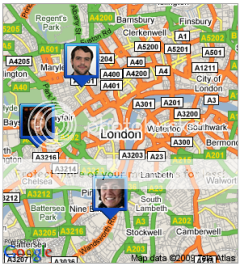
The reaction to this stuff finally arriving for the masses hasn’t all been positive, though. The response to the UK launch of Google Latitude – Google’s mobile application for sharing your location with friends from your Google contact list – is a good example.

A threat to privacy?

Privacy International said that “…Google has created an unnecessary danger to the privacy and security of users…”. They argued that it was too easy for Latitude to be “…enabled by a second party without a user’s knowledge or consent…” and that once enabled it could remain undetected for a long time, with massive potential for abuse.
Liberal Democrat MPs Tom Brake and my local MP Chris Huhne submitted an Early Day Motion to Parliament arguing that Latitude “…could substantially endanger user privacy…” and that “…Google has created an unnecessary danger to user privacy…”.

Tom Brake followed this up with the now widely reported quote that “Google Latitude poses an insidious threat to our hard-won liberties“.

I personally think this was unnecessarily alarmist, but at any rate, it is clear that the model of granting ongoing access to your location (until / unless you revoke it) worries some people.

(more…)

Vtech Kidizoom

Thursday, January 1st, 2009

Top of Grace’s Christmas list for Father Christmas was a camera.

In the end, Santa went with the Vtech Kidizoom.

Faith - Grace's baby sisterIt was tough to find many reviews for it, so I thought I’d share a few of Grace’s snaps with it so far, for anyone interested to see what the image quality is like – all of the photos in this post were taken by Grace (our 4 year old) with the Kidizoom.

The camera cost £40, and produces JPEGs with a resolution of 640×480. There is about 12 MB of storage in the camera, which has enough space for at least a couple of hundred pics, and an SD card slot if you need more space.

DC00029

The pictures are a little fuzzy, but Grace is certainly happy enough with them.

The camera does have a flash, which means indoor pics are possible.

It can be tricky getting the distance right when using the flash – too far away and the flash is no use at all and the picture is very dark, too close and the flash is too bright creating a bright white picture. (Although this has created a couple of neat pics such as this one!)

(more…)

CurrentCost – the CC128

Monday, December 29th, 2008

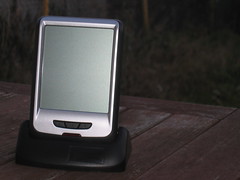
CC128 - the new display unitThe nice people at CurrentCost were kind enough to let me have a pre-production version of their next home electricity monitor to play with: the CC128.

I’ve been meaning to post some thoughts about it for a few weeks now, but the run up to Christmas meant it got forgotten.

But I finally had a bit of time to give it a try today.

If you already know about CurrentCost meters, nothing here will surprise you – this is more of a refinement to the current design, rather than something new and different. (If you don’t, I’ve written about CurrentCost meters before – this new one is just the same, except with a new display unit).

There are some improvements here that I like.

(more…)

CurrentCost – setting yourself a personal goal

Sunday, December 14th, 2008

One of the themes that came up at HomeCamp was that collecting data about personal energy usage was good, but putting it in a broader context helped make it more effective.

With that in mind, I thought I’d make a small improvement to my CurrentCost app to add a financial context to the data it displays.

I’ve added the ability to specify an annual electricity usage target – it asks the question “How much do you want to spend on electricity in a year?”

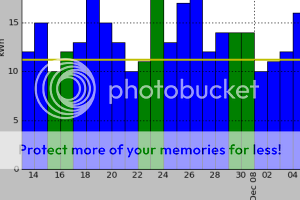
screenshotOnce you answer that, a target line is added to each graph. The target line shows how much electricity you should use in order to meet your goal.

For example, the graph showing daily electricity usage has a horizontal line showing how much electricity usage you can use a day in order to meet your target annual electricity spend. Bars in the graph that are taller than the horizontal line show you exceeding your goal, bars that stay under show you on track.

(more…)

HomeCamp

Sunday, November 30th, 2008

Yesterday was HomeCamp:

…an unconference about using technology to monitor and automate the home for greener resource use and to save costs. This is about low energy devices and servers, reducing your electricity bills, monitoring your mouse traps, home automation, monitoring your water usage, using solar power…

Fifty or so people came together at Imperial College to talk about how we can reduce our energy usage.

The format was different to other barcamps and unconferences I’ve been to – rather than separate rooms, most of the time was spent with everyone together in a single room. And the talks flowed on from each other – it felt more like a single day-long conversation than a series of separate presentations.

(more…)

Developing for Android

Wednesday, November 26th, 2008

I wrote an admittedly gushing post a few weeks ago about my first impressions of the new “Google phone”, the Android-powered T-Mobile G1. Now that I’ve had a few weeks to play with it, I thought I’d add a comment about some frustrations with it as a developer.

None of this is to retract what I said before – I still agree with what I said before. But it’s worth adding a couple of comments.

I’ve not written any code for Android yet, but I’ve had a couple of tentative looks into how I might. And in general, it seems to be a combination of being really impressed by the theory, followed by being frustrated by the practice.

This is perhaps best described with a couple of examples.

(more…)