I’ve submitted a Flink Improvement Proposal (FLIP) about adding support for Flink to be able to fetch remote jars for applications submitted to a session cluster.
Posts Tagged ‘apacheflink’
Adding support for remote jar fetching in Flink session clusters
Sunday, August 23rd, 2026Running Flink jobs in MiniCluster using the Kubernetes Operator
Wednesday, August 5th, 2026I’ve submitted a Flink Improvement Proposal (FLIP) about adding support for the Flink Kubernetes Operator to run Flink’s MiniCluster in a single pod for low-throughput jobs that require isolation.
In the last few weeks, I’ve been working on a proof-of-concept to demonstrate the feasibility of this idea. I’ve done enough to convince myself that this is viable and identify where the issues will be, but I’m looking for community feedback before I take it much further.
Background
The Flink Kubernetes Operator is one of the best ways to run Flink jobs. From the documentation:
Flink deployments are declared like any other Kubernetes workload, and the operator runs their whole operational life:
- Lifecycle Management: deployment, stateful upgrades, rollbacks, and self-healing
- Zero-Downtime Upgrades: blue/green deployments that switch over only once the new version is proven healthy
- Autoscaling: parallelism and memory continuously right-sized to the observed load
- Kubernetes-Native Operations: Helm installation, RBAC, high availability, metrics, logging, and ingress
You create a FlinkDeployment Kubernetes custom resource that points to your Flink application, and the Operator handles provisioning independently schedulable and independently configurable Job Manager Deployment and Task Manager Deployment, configuring them to form a distributed Flink cluster.
This provides scalability and high availability, and is the right approach in a lot of situations. However, this comes at the cost of a fixed baseline cost of at least one JobManager pod and one or more TaskManager pods.
A smaller, lighter-weight alternative would be useful for small or intermittent jobs, where the minimum resource cost of two separately-scheduled pods is disproportionate to the job itself.
A single-pod, self-contained Flink job that starts fast and needs no multi-pod coordination could be a good fit for low-throughput jobs that aren’t suitable for session clusters because they need isolation.
Embedding Tiny Language Models in Flink SQL
Wednesday, May 20th, 2026I gave a talk at Current yesterday about how to embed a tiny language model inside your Flink SQL pipeline.
I used a fun mix of demos to show what I think are the main approaches available for using generative AI with Kafka events from a Flink SQL job. Some demos were definitely more sensible than others!
These are the slides I used, and what I’d planned to say.
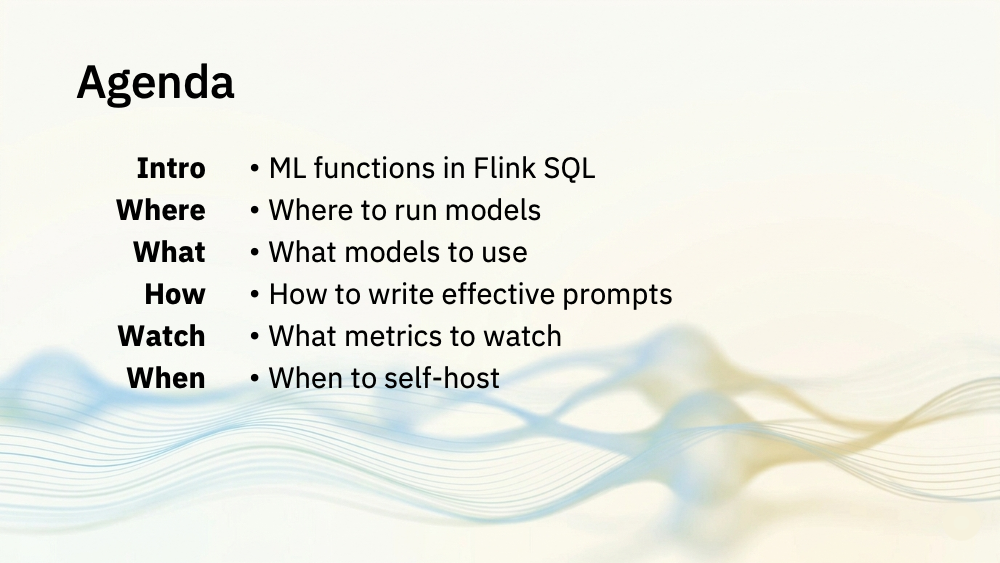
In this session, I’ll be talking about your options for running language models for Flink SQL jobs.
I’ll cover:
- your options for where you run them, in relation to Flink
- what sorts of choices you have for the models you run
- how to use them – the sorts of prompts and settings we’d want for Flink
- how to keep an eye on it that it’s working well
- and finally, some thoughts on when it’s a good idea to do any of this
“How many Kafka events will Flink process per second?”
Saturday, April 11th, 2026I’m often asked this. The specific question varies, but it’s typically some variation of asking how quickly a single CPU of Flink processes events from a Kafka topic.
Why “per CPU”? Maybe because enterprise software is typically charged per CPU? Maybe because I tend to talk to people who run everything in Kubernetes, who think of running software in terms of requests / limits? Not sure, but the question tends to be framed from the perspective of asking how much processing they can expect to get from a CPU.
I try to avoid doing the engineer thing of answering “it depends“… but… it really does depend!

That is the motivation behind this post: to give me something I can point at as an illustration of the degree to which Flink’s performance varies (and a taste of the range of interrelated factors that influence it).
Extending Flink SQL
Sunday, March 29th, 2026In this post, I’ll share examples of how writing user-defined functions (UDFs) extends what is possible using built-in Flink SQL functions alone.
I’ll share examples of how UDFs can: