How good is my mobile network operator?

March 17th, 2009

I’d like to think that I’m normally a fairly easy-going person, but we all have our pet peeves and for me one of mine is my mobile phone network operator. They drive me nuts – I never get a signal anywhere!

Or at least, so I thought.

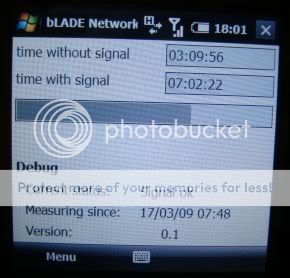
Last night, I put together a quick test to keep track of how much time my phone doesn’t have a signal.

It is technically very simple to do, but I’ll describe how it works in a moment. First, the results. Today was a “typical” work day – I spent most of it at my desk which is by a window on a first floor. I don’t work in a lead-lined bunker, and I didn’t hide the phone in a microwave (does that even work?) or anything like that.

I started the test at home this morning, when I normally start checking my emails and twitter. And it’s been running all day. While in my office, the phone was on my desk. The rest of the time it’s been in my pocket.

It looks like I have a signal more often than I thought – for over seven hours it had a signal, with only a little over three hours with no signal. I was expecting a result with time without a signal being greater than time with a signal.

This is hardly a scientific test, but I wonder if my perception is worse than reality? Maybe all it takes is a few times for the phone to not have a signal when I need it for me to get the impression that it “never” has a signal.

Read the rest of this entry »

Charity auction for Comic Relief

March 11th, 2009

I generally try and avoid using my blog to ask for help for Solent Youth Action – the last time I remember doing it was back in 2007 when I was looking for mentors for our new mentoring scheme.

So I hope you’ll forgive me now if I try and use my space here to ask for support for an SYA event coming up.

If you are near Hursley next Monday (16th) afternoon, please come along to the Clubhouse at 2.30pm.

Young volunteers for SYA are refurbishing old furniture: restoring it, cleaning it, and decorating it. They hadn’t done anything like this before, so it has been a great opportunity to them to learn new, practical skills.

The furniture was all donated – these were items that otherwise would’ve been thrown away, making it also a good chance to teach a valuable reduce, reuse, recycle message.

The fruits of their labour will go on sale in a charity auction to be held in the Clubhouse, with all money received to be donated to Comic Relief.

Please come along and take a look at what they’ve been working on.

More details about the event, and the items of furniture that the young people are working on, can be found on the SYA website.

Beginner’s guide to writing a Firefox extension

February 22nd, 2009

Last week, I shared my hack for syncing my browsing between my computer and mobile. It’s built around a Firefox extension, so I thought I’d share my notes on how I got it to work.

screenshotThis post is a complete sample for creating a Firefox extension to add a button to the browser toolbar. When you click on the button, it grabs the URL from the Firefox address bar and does something with it.

I’ve gone through each file you need, explaining what it’s for and giving a sample ready for copy-and-pasting.

In my browser sync hack it sent the URL to my phone, but for this walkthrough I’m going with something simpler: opening the webpage in Internet Explorer. You can replace that bit of script with something more useful 🙂

I’m not an expert at this stuff by any means, and I found a lot of useful code snippets on mozilla.org to get me going. But this seems to work, and as people that I’ve shown my extension to so far seemed surprised at how easy it was, I thought it might be useful to share.

Apart from the Internet Explorer bit itself (which is a little Windows-specific), the rest of this should all work wherever Firefox does.

Read the rest of this entry »

Programmatically getting last visited page from Pocket Internet Explorer

February 17th, 2009

I wrote earlier about my hack for syncing my browsing between my computer and mobile.

One of the most fiddly bits of implementing this was how to get the last visited page from Pocket Internet Explorer on my phone. In case this is useful to anyone, here is a quick description of how I did it.

I wrote the code to get the last visited page in C++. I couldn’t find any way to access the browser, or the address bar, programmatically.

The closest I could find is a set of Windows Internet Services API calls which let you have direct access to the browser cache used by Pocket Internet Explorer.

I wrote the code for Pocket Internet Explorer on Windows Mobile, but to the best of my knowledge it should work on regular Internet Explorer. I’ve not tried it because, let’s be honest, who uses Internet Explorer? 😉

The approach was to use FindFirstUrlCacheEntryEx and FindNextUrlCacheEntryEx to enumerate through the INTERNET_CACHE_ENTRY_INFO entries in the Internet cache.

Each INTERNET_CACHE_ENTRY_INFO item stores (amongst other information) the URL it was downloaded from, and the time the cache item was last accessed.

So I find the last page the user has visited by enumerating through the cache, and store the URL for the cache item with the latest last-accessed time.

Read the rest of this entry »

Syncing browsing between mobile and computer

February 17th, 2009

Imagine the scene.

You are sat at your computer, reading a fascinating article online.

You’re about halfway through reading it when something comes up and you need to leave your desk.

Wouldn’t it be great if you could finish reading the page on your mobile? (Without needing to remember how you found the webpage, or what the URL is?)

With this Firefox extension, you can. 🙂

screenshot

Read the rest of this entry »

Responding to the state of the National Grid

February 15th, 2009

Okay, I know I said I’d stop banging on about CurrentCost stuff… sorry. My next post will be about something different. Honest! 😉

But with talk about Home Camp 2009 starting to pick up, it seems like a good time to remember one of the interesting factoids I picked up at Home Camp last year.

As I wrote at the time:

…the frequency of the electricity you receive from the National Grid is proportional to the ratio of supply vs demand for electricity usage on a national level…

There was a lot of discussion about how this information could be used to make a difference.

This is discussed in more depth at dynamicdemand, but the sort of thing we talked about was how you could make a significant difference without reducing your total electricity usage at all, but by shifting your usage to times when national supply is greater than the demand, and so when the energy is cheaper and more efficient to produce.

As I wrote at the time, it might be interesting to see what this looks like plotted against your own personal electricity usage.

Demonstrating my lightning quick l33t development skills, only ten weeks later, I got round to trying it out. 🙂

Read the rest of this entry »

Getting data from the CurrentCost CC128

February 7th, 2009

I really need to stop blogging about CurrentCost stuff, this is starting to look like an obsession 🙂

But before I do that, I thought I’d share my experiences in writing a new CurrentCost parser.

What is this all about?
On the off-chance that anyone following me hasn’t already heard about CurrentCost a million times already, CurrentCost meters are domestic electricity monitors that tell you how much electricity your household is using. And they have a connection underneath that lets you grab the data from them.

As well as getting your current electricity usage, you can also get historical usage totals out of the serial port, which I’ve used in a variety of ways, such as in my Python CurrentCost software.

CurrentCost have now brought out a new model of their monitor – the CC128. The data format is different to the current models, so I wanted to try and write a new parser that could handle both the existing model and the new CC128 data.

Read the rest of this entry »

Revisiting my Twitter Glossary

January 11th, 2009

Have you ever read someone’s tweet and not known what they are on about?

At IBM HackDay 5, I played around with an idea for a Twitter hack – a Twitter Glossary that would let users define terms they regularly use in tweets. The idea was that followers would see the definitions appearing as tooltips over those words when they appear in tweets.

screenshot of the firefox extension

I described the idea in more detail here. It’s now available for anyone to try.

Read the rest of this entry »