Archive for the ‘code’ Category

Improving TwitToday – more Today Screen coding

Wednesday, July 23rd, 2008

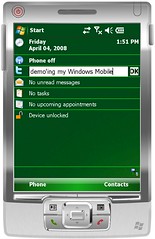
Twitter client for Windows MobileApart from adding the ability to initiate an internet connection, my Twitter widget for Windows Mobile Today screens is still virtually the same code as I wrote in a few hours overnight at the Over The Air hackday.

Which isn’t great – as I know there have been a bunch of people waiting for me to make some fixes and add some basic features.

Tonight I had a bit of time to spare, so I finally dug out the code to start making a few improvements:

  • Background worker thread
    Today screen widgets are compiled into DLLs. They aren’t a separate executable, and are run by the Today Screen in the Today screen’s (i.e. explorer.exe’s) flow of execution. When the code tries to post to twitter.com, explorer can’t do anything else until that’s finished.

    That might even be tolerable with most websites, but with twitter – which is known to fall over from time to time! – it means TwitToday could effectively hang your phone for ages until the HTTP post timed-out.

    Not good. Now it does all the HTTP work in a background thread, so you can get on with other stuff while it tries to send your tweet.

  • SIP support
    This was asked for a lot. The Today screen doesn’t include the button to show/hide the on-screen stylus/finger keyboard. So if your mobile doesn’t have a keyboard, TwitToday wasn’t much use.

    I’ve added a setting now that lets you programmatically show the SIP keyboard when you tap on the text box.

If you want to try the new version, you can download it from here. If you want to see how I did it, read on.
(more…)

Fun with MQTT

Friday, July 18th, 2008

I’ve been quiet for the past month or so, as I was keeping my head down to finish a project at work. It’s done now, so now is a good time to crawl back out of my cave and share a bit about what I’ve been up to. This was for a customer who outsourced a software development project to us.

Some quick background: MQTT is a publish/subscribe messaging protocol that IBM products like WebSphere Message Broker can speak.

Our customer wanted an MQTT library written for the real-time embedded firmware that runs on their products. This client library needed to provide the API of the MQTT specification, implemented within the constraints of an embedded platform with significant resource constraints, and only a subset of the standard C OS functions (e.g. no multi-threading, no dynamic memory allocation, no malloc/realloc/calloc, etc.).

(more…)

Our Mashed 08 hack: CurrentCost Live

Monday, June 23rd, 2008

Yesterday was the end of Mashed 08 – the annual London hackday from BBC Backstage.

I saw last week that there was going to be a “social responsibility” category in the hack challenge, and decided that a CurrentCost hack was in order!

Together with Rich, we spent a day trying to hack together a competitive challenge based around CurrentCost, encouraging people to reduce their home electricity usage by making it into a game they can play with their friends.

Here are a few notes based on the presentation I gave at the end.

(more…)

Tweaking the CurrentCost app

Monday, June 16th, 2008

tweaking the CurrentCost GUI

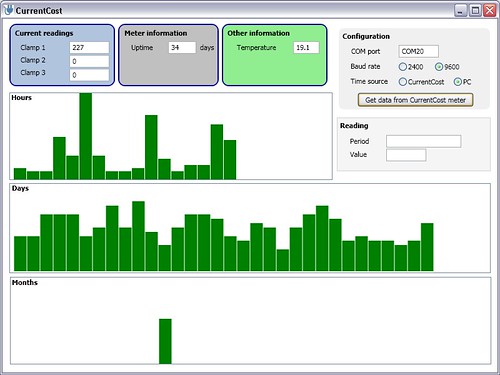
I spent a bit of tonight tweaking last night’s CurrentCost app.

Not a lot to say about it, as it’s more or less the same as it was last night…

(more…)

CurrentCost – getting the history into Windows

Sunday, June 15th, 2008

The CurrentCost meter has been ignored of late as I’ve been a bit busy with other things. Tonight, I started playing with it again.

The plan
The more geeky amongst us have connected the CurrentCost to a server of some sort. By connecting it to something that’s always on, we can collect a history one reading at a time. But what about people without a server? How can they collect history?

As Rich highlighted in his post on the CurrentCost XML output, the CurrentCost meter maintains some running totals in flash memory, and these are included with updates for every reading from the device.

It maintains:

  • totals for each two-hour block for the last day
  • totals for each day for the last 31 days
  • totals for each month for the last 12 months
  • totals for each year for the last 4 years

This means that if you store and aggregate these history totals, you can connect the meter to a computer periodically and still get reasonable CurrentCost readings history.

  • connect at least once every 26 hours to maintain the two-hourly history
  • connect at least once every 31 days to maintain the daily history
  • connect at least once a year to maintain the monthly history
  • connect at least once every four years to maintain the yearly history

Okay, so the two-hourly history might be a bit much, but the others all seem reasonable, even for non-geeks!

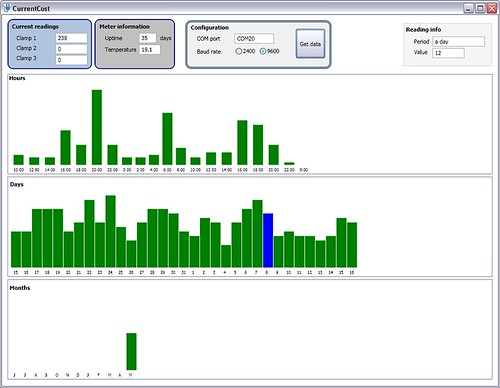
So, the plan is to write a simple Windows application that a user could periodically link to a laptop or computer that will collect CurrentCost readings and aggregate them into history data. And ideally then display them in a pretty way

(Not my plan, incidentally, but rather one that I nicked from Andy. Still, if you’re gonna nick ideas, there are worse places to start… 🙂 )

This is what I’ve got so far…

the start of a CurrentCost GUI

(more…)

CurrentCost hacking – starting to identify appliance power usage

Tuesday, June 3rd, 2008

I needed a break from work tonight, so went back to playing with the CurrentCost meter – a chance to try a few new things.

The objective
I want to make a start on identifying how much electricity different things in my house use. To begin, I’m going to start with a very manual user-driven approach:

Subscribe to updates from the CurrentCost meter, and when a significant change in usage occurs, ask me what I’ve just switched on or off, and collect that information to build up a record of how much electricity different devices use.

How?
It’s already quite late, so I just wanted to hack a quick first version together. I decided to write it as a small Java app.

As I’ve mentioned before, I’m publishing the CurrentCost readings to a small broker running on my home server. The plan was to write a Java application that uses MQTT to subscribe to updates from the broker.

Why? Because I’ve not used Java on the Slug before, or with MQTT. (Is that not a good enough reason? 🙂 )

I’ve written it as a command-line app, because it’s a quick way to run it from different devices around the house. (That is, by cheating 🙂 I’m actually running the app on the home server, using PuTTY / PocketPuTTY / SSH etc. to run it from my ThinkPad, PDAs, mobile, EEE PC, etc.).

(more…)

Back at work… gradually

Sunday, June 1st, 2008

Hurrah – after a two and a half weeks being stuck at home, the doc tells me that my back is well enough for me to go back to work tomorrow.

I’m not fully recovered – the estimate for that is still 6 – 8 weeks, so I’m been warned to take it easy for a few weeks. In particular, he made it very clear that I must get up and stretch my legs regularly, as prolonged periods sitting could set my recovery back.

screenshotUnfortunately, I know I have a habit of being a bit single-minded (some might say “obsessive” 😉 ) while I’m working, and often lose track of time. So I’ve thrown together a 35-line program to help make sure I don’t overdo it.

It will automatically lock my ThinkPad after 40 minutes, resetting the timer each time I unlock the ThinkPad again.

(more…)

Capturing Bluetooth events in Windows Mobile

Friday, May 30th, 2008

I wrote on Sunday about writing Bluetooth code for Windows Mobile for a location-based reminder app I hacked together.

At the time, I wrote about two main approaches for finding nearby Bluetooth devices:

  • searching for discoverable devices
  • registering for notifications for when paired devices connect and
    disconnect

For the location-based reminder app, I went with the first approach, and played with how to search for discoverable devices.

This afternoon, I tried out the other way – writing an app that registers with the OS for connect and disconnect notifications from paired devices.

(more…)
